Predictive marketing — talking to customers, not categories.

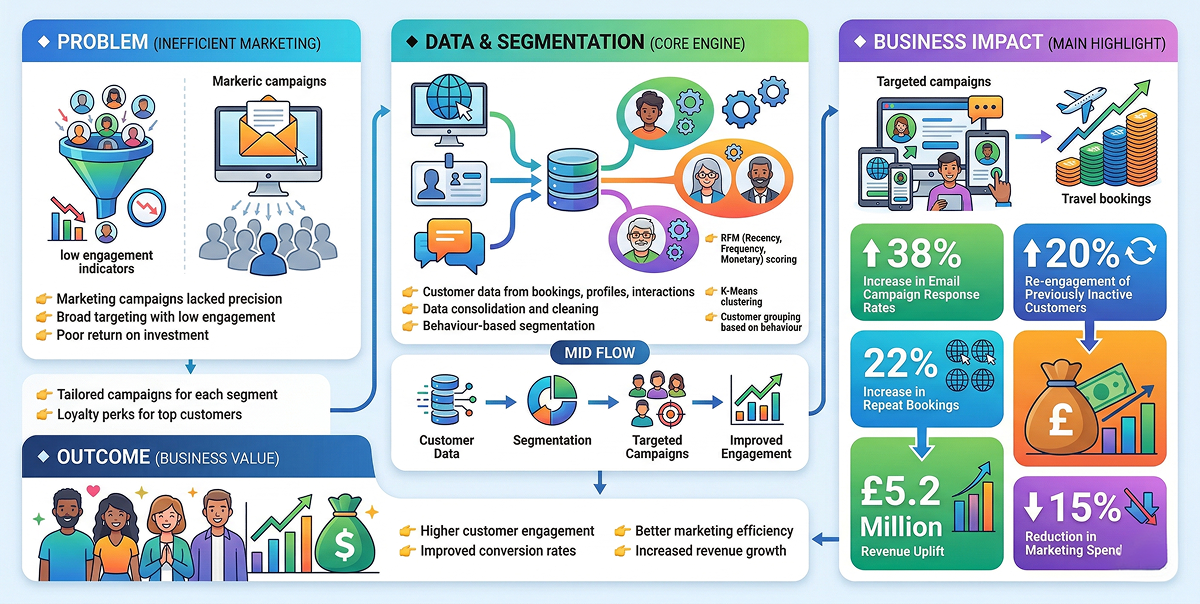
A global travel company's marketing campaigns lacked precision despite capturing vast customer data. Decision Studio implemented RFM scoring and K-Means clustering to create intelligent customer segments, driving a 38% surge in email campaign response and a 22% increase in repeat bookings.
To address this challenge, Decision Studio embarked on a comprehensive data science initiative aimed at transforming the company's marketing strategy. The first step was to clean and consolidate customer data from multiple sources, including booking history, interactions, and customer profiles. Decision Studio then implemented a powerful segmentation strategy using RFM (Recency, Frequency, Monetary) scoring to understand customer behaviour. This was followed by advanced clustering techniques, specifically K-Means, to create meaningful customer segments based on behavioural patterns. Each group received a tailored marketing approach, ranging from loyalty perks for top customers to re-engagement campaigns for at-risk segments. The goal was to make every campaign as personalized and relevant as possible to each customer's behaviour and value.
38%
38%
surge in email campaign response
20%
inactive customers re-engaged
22%
increase in repeat bookings
15%
reduction in marketing spend
In addition to increased revenue, the company was able to reduce marketing spends by 15%, all while improving conversion rates and customer engagement. This initiative not only transformed the company's marketing strategy but also turned customer engagement into a powerful, revenue-driving force, proving the value of data science in enhancing both customer experience and business performance.